


%20(1)_edited_edited_edited.png)
From Confusion to Clarity: Building a System for MTSS to Special Education Referrals

Updated: Mar 17
The Reality in Schools
In most schools, the breakdown is not in intervention.
It’s in what happens after intervention.
Teams identify students. They provide support. They collect data.
And then they hit the same question:
“Do we refer this student for special education… or not yet?”
What should be a clear decision point often becomes one of the most confusing parts of the system.
Even when districts provide guidance, schools still struggle with:
When to act
What data is required
Who is responsible
What “enough” actually looks like
The result is inconsistency.
Some students are referred too early. Some too late. Some not at all.
Not because people don’t care but because the system is not clear.

The Problem
One of the most persistent breakdowns in schools is not a lack of intervention.
It’s what happens after intervention.
Across schools, I have seen the same patterns:
Uncertainty about when to move from intervention to referral
Inconsistent documentation across teachers and teams
Delays in decision-making due to missing data
Referrals based on urgency or frustration instead of clear criteria
This creates variability.And variability creates inequity.
The System
To solve this, I designed a clear, structured MTSS → Special Education Referral System anchored in one central tool:
This system organizes the referral process into a transparent, step-by-step pathway that removes ambiguity and ensures consistency across teams.
1. A Defined Decision-Making Process
The system follows a structured progression:
Initial concern identified
Data gathered by general education
Problem-solving team review
Intervention planning and implementation
Progress monitoring
Evaluation of impact and decision to refer
This aligns with the six-step decision-making process outlined in the referral system and ensures that referrals are based on data, not opinion.

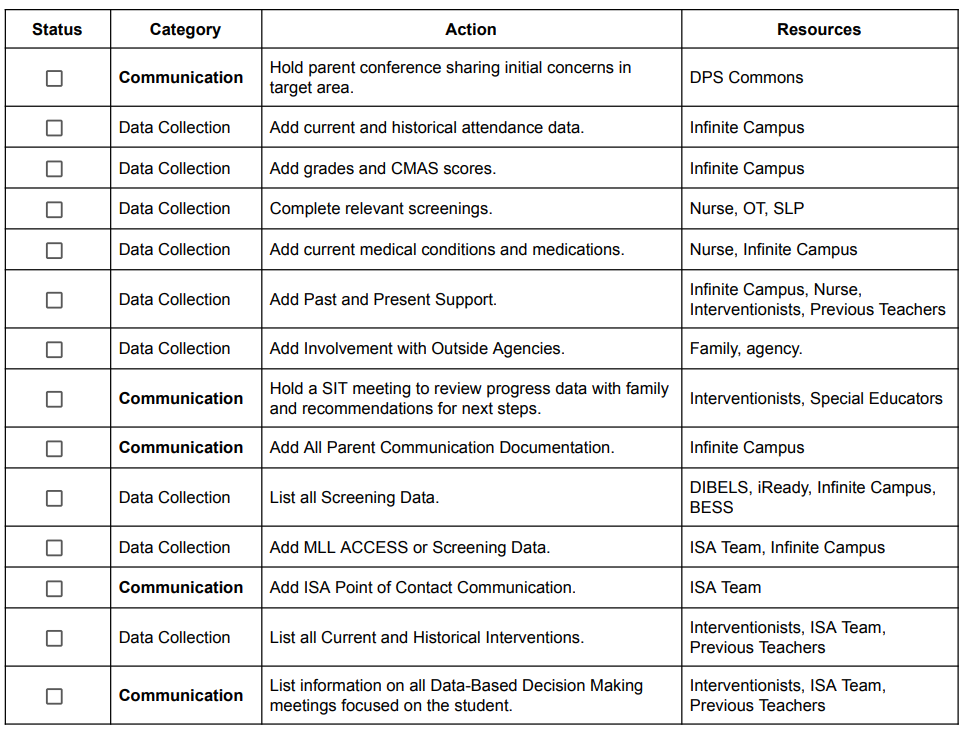
2. Clear Data Expectations
One of the biggest sources of confusion is:“What do we actually need before referring?”
This system removes that guesswork by requiring:
Attendance and historical data
Academic performance and screening data
Intervention history and progress monitoring
Family communication documentation
Health, vision, and outside agency input
As outlined in the checklist (page 2), teams must compile a complete body of evidence before moving forward.
3. Built-In Team Structures
The system centers the Student Intervention Team (SIT) as the decision-making hub.
Data is reviewed collaboratively
Families are included
Next steps are clearly defined
This ensures referrals are:
Collaborative
Transparent
Consistent

4. Data-Driven Movement Between Systems
A critical shift in this system is moving from:
“I think this student needs testing”
to:
“The data shows this student is not responding to intervention”
As outlined in the process (pages 7–10), decisions are driven by:
Progress monitoring trends
Rate of improvement
Response to intervention
Ongoing review every 4–6 weeks
This creates a clear threshold for movement from MTSS to referral.

5. Guardrails for Equity
The system includes safeguards to ensure equitable and appropriate referrals:
Attendance and external factors are addressed first
Multilingual learner processes are followed
Outside evaluations are considered appropriately
Immediate referrals are allowed when warranted
The Impact
When implemented with fidelity, the shift is immediate.
For Teachers
Clear understanding of when and how to refer
Reduced stress and uncertainty
For Teams
Consistent expectations
More efficient meetings
For Students
Faster access to support
Fewer delays in identification
The Bigger Shift
This is not just a form.
It is a shift from:
Reactive → Proactive
Opinion-based → Data-driven
Inconsistent → Systematic

The Core Belief
Clarity → Consistency → Better Outcomes
When the path is clear, people act.
When people act consistently, systems improve.
And when systems improve:
Students win.
Closing
Special education referral should not be a gray area.
It should be a clear, structured decision within a system designed to support students.
This system ensures that happens.
Because when the system is clear…
Students don’t fall through the cracks.
Comments