


%20(1)_edited_edited_edited.png)
When Intervention Became a System: Building Response to RTI in Elementary

Updated: Apr 5
One of the most important leadership projects of my early career was building my first fully realized schoolwide MTSS program.
I called the system Response to RTI, and it was designed to help the school move from scattered intervention efforts to a more coherent, schoolwide process for identifying student need, planning support, monitoring progress, and adjusting interventions across the year. What began as an intervention framework became something larger: a leadership structure for how a school organizes its response to academic need. The system was built across the full school year, from pre-service planning through end-of-year transition and next-step recommendations.

The leadership problem
The challenge was not that people did not care. The challenge was that the work was too fragmented.
Interventions were happening, but too much depended on individual memory, isolated conversations, and loosely connected documents. Students were sometimes pulled at inconsistent times. Teachers could feel interrupted by multiple adults serving students across the day. Some students missed core instruction in order to receive support. Teams had data, but not always a unified structure for turning that data into timely schoolwide decisions.
That is a leadership problem, not just an intervention problem.
At this school, I saw the need for a system that could create more consistency across classrooms, reduce confusion for staff, protect instructional time for students, and give the school a clearer framework for making support decisions. This work was about building organizational clarity, not just intervention groups.
The system I built
Response to RTI became a full schoolwide intervention model organized around major implementation areas: infrastructure, data systems, screening, progress monitoring, fidelity and evaluation, communication and collaboration, intervention planning, student support, data-based problem solving, and training.
The strength of the system was not any one form or flowchart. It was the way all of the pieces worked together.

Infrastructure that made the work possible
I began by building the infrastructure because schools cannot run strong intervention systems on good intentions alone. The framework included timelines, assessment plans, scheduling documents, session calendars, master schedules, staff availability tools, team role documents, and guidance for movement between tiers.
From a leadership standpoint, this mattered because infrastructure creates predictability. It makes expectations visible. It reduces the number of decisions adults have to invent in the moment. It helps a school shift from reactive problem solving to proactive planning.
One of the most important operational decisions in the system was creating a consistent intervention block within the master schedule.
That decision helped solve three major schoolwide issues: students missing work while out of class, students with the greatest needs missing Tier 1 instruction, and multiple adults pulling students throughout the day in ways that distracted students and frustrated teachers.
That is exactly the kind of move that reflects school leadership. It is not just about helping one student. It is about organizing the day so the system works better for everyone.

 |  |  |
Data systems that supported decision-making
I also built a schoolwide intervention database that tracked students receiving Tier 2 and Tier 3 supports, services provided, prior data, progress over time, and changes across intervention sessions. The system also produced reports related to service counts, schoolwide achievement trends, and individual student information.
This was a leadership move because schools need shared visibility into the work. When intervention data lives in isolated spreadsheets, emails, or individual notebooks, leaders cannot see patterns clearly enough to make strong decisions. A stronger data system helped the school move from “Who is working with this student?” to “What is our schoolwide response to student need, and how do we know it is working?”
In practical terms, this improved organizational coherence. It gave the team a central place to document support, monitor changes, and review trends instead of relying on memory or disconnected records.

 |  |  |
Screening and progress monitoring with clear expectations
The system included assessment flowcharts and semester assessment guides that clarified what screening happened, when it happened, and how results should be used. It included universal screening, benchmark screening, diagnostics, formative assessment, and curriculum-based measurement.
More importantly, the process connected assessment to action. Teams were expected to review results, analyze student need, schedule support, and revisit decisions during designated points across the year.
This is another area where the leadership lens matters. Screening alone does not improve outcomes. A school improves when leaders create structures that help adults use data consistently and in a timely way.
Progress monitoring was also built into the system through guidance documents, training supports, certifications, fidelity checks, missing-data follow-up, and communication tools. Families were not left out of that process. Weekly progress-monitoring notes were designed to help families understand student growth, current performance, and goals in a more accessible way.
That piece reflected a leadership priority for me: if a system is truly schoolwide, it should create more clarity not only for staff, but also for families.

 |  |  |

 |  |  |
Fidelity and evaluation built into the system
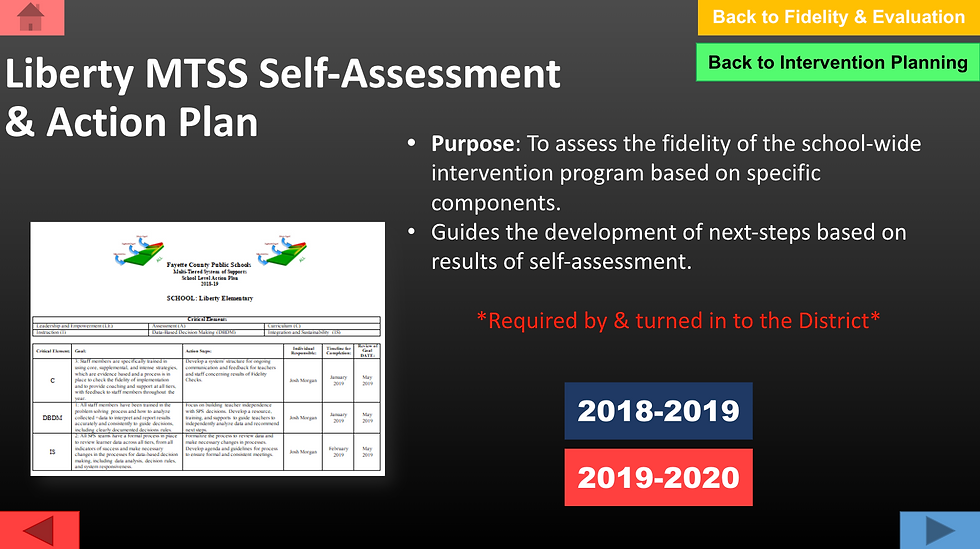
One of the most leadership-centered parts of the project was the emphasis on fidelity and self-evaluation. The system included fidelity monitoring tools, academic fidelity checklists, progress-monitoring fidelity checks, missing-data follow-up, self-assessment processes, and action planning tools.
That mattered because strong leaders do not assume a system is effective just because it exists. They build in ways to check implementation, identify weak points, and make adjustments.
This part of the work pushed the school toward a more accountable model. It made intervention a monitored system rather than a loosely defined support structure. It also reinforced an important leadership message: consistency matters, and implementation quality matters.

 |  |  |
Communication and collaboration that increased trust
I also built communication structures for teachers and families, including parent notification letters, brochures, progress-monitoring guides, scheduling meeting documents, recommendation flowcharts, contact lists, and family meeting processes for Tier 3 students.
This strengthened the school’s communication around intervention in two ways. First, it gave teachers clearer pathways for understanding support recommendations and next steps. Second, it helped families understand when students entered intervention, what type of support they were receiving, and how progress would be communicated.
Leadership is not just designing the right process. It is also making the process understandable enough that people trust it.

 |  |  |
Intervention planning, student support, and referral structures
The framework also included active intervention lists, intervention plans by tier, lesson plans, student support request tools, movement-between-tier guidance, one-on-one interventions, parent referral meeting supports, and special education referral documents.
This helped the school create a more coherent pathway from concern to action. It reduced the likelihood that staff would skip over intervention planning or move too quickly from concern to referral without a clearer problem-solving process.
That is a strong school leadership outcome. It strengthens consistency, protects decision quality, and creates a more reliable support system for both staff and students.

 |  |  |

 |  |  |

 |  |
Training and implementation support
Finally, the system included staff training for opening day, team meetings, screening, progress monitoring, lesson planning, intervention planning, and data analysis. Staff were not expected to figure out the system on their own. Training was part of the design.
From a leadership perspective, that matters because sustainability depends on adult learning. A system is only as strong as the staff’s ability to understand and implement it. By embedding training into the rollout, I was not just creating a program. I was building implementation capacity across the school.

 |  |  |
Leadership impact
The most important impact of this work was not just that intervention became more organized. It was that the school had a more reliable framework for responding to student need.
This project improved clarity around timelines, roles, and next steps. It created more consistency in how support was planned and adjusted. It helped protect Tier 1 instruction through stronger scheduling. It strengthened the school’s use of data for student support decisions. It improved communication with staff and families. It also made the work more sustainable by documenting processes that otherwise might have remained informal or person-dependent.
That is the kind of impact I care most about as a leader: building systems that make good practice more likely, not just possible.
What this project taught me about school leadership
Building Response to RTI shaped the way I think about leadership to this day.
It taught me that many school problems that look instructional on the surface are actually structural underneath. It taught me that schedules, systems, and communication tools are not secondary to student support. They are part of student support. It taught me that clear systems reduce adult stress and improve follow-through. And it taught me that the most effective leadership often happens by building the conditions for better decisions across an entire school.
This project was one of the first times I fully stepped into leadership as a systems builder. I was not only helping students directly. I was designing the structures that helped the school respond to students more effectively, more consistently, and with greater shared ownership.
That is still the kind of leadership I want to practice.
Problem → System → Impact

 | Problem This elementary needed a more coherent way to respond to academic needs across the school. Intervention efforts existed, but too much depended on scattered documents, informal communication, inconsistent scheduling, and unclear decision-making. This created confusion for staff, reduced consistency for students, and made it harder to protect core instruction while delivering targeted support. |
System I designed and led the implementation of Response to RTI, a schoolwide MTSS framework that organized intervention work across infrastructure, scheduling, screening, data systems, progress monitoring, fidelity, communication, intervention planning, student support, and staff training. The system included flowcharts, timelines, databases, meeting structures, intervention planning tools, and family communication resources that helped the school move from fragmented practices to a more shared and sustainable model. |  |
 | Impact This work created greater clarity, consistency, and shared ownership across the school’s intervention process. It helped protect Tier 1 instruction through stronger scheduling, improved the school’s ability to use data for support decisions, strengthened communication with staff and families, and made intervention systems more visible and sustainable. Most importantly, it gave the school a more reliable structure for responding to student need and reinforced my development as a systems-minded instructional leader. |

Comments