


%20(1)_edited_edited_edited.png)
Why Role Clarity Matters in High-Support Classrooms

One of the fastest ways a high-support classroom starts to break down is when adults are working hard, but not working with enough clarity.
In specialized programs, strong student support depends on strong adult coordination. Teachers, paraeducators, related service providers, and leaders may all be supporting the same students across instruction, behavior, communication, transitions, and daily routines. When roles are unclear, even committed teams can end up duplicating work, missing important responsibilities, or creating confusion for students.
That is why role clarity matters so much.
In high-support classrooms, role clarity is not about hierarchy for the sake of hierarchy. It is about building a system where each adult understands their responsibilities, how their work connects to others, and how the team functions together in service of students.
High-support classrooms require more than goodwill
Specialized classrooms are complex by design. Students may need individualized instruction, behavior support, communication systems, accommodations, adaptive materials, and carefully structured routines throughout the day. In that environment, it is not enough for adults to simply “help where needed.” Strong classrooms need clear systems for who plans, who delivers, who monitors, who documents, and who communicates.
The responsibilities document I use in my MI work makes that distinction explicit. It separates teacher and paraeducator roles across instructional planning and delivery, behavior management and student supervision, data collection and assessment, classroom preparation and organization, student support and advocacy, and collaboration and professional growth. For example, the teacher role includes developing IEPs, adapting curriculum, delivering core instruction, overseeing behavior plans, interpreting data, and leading collaboration with families and related service providers, while paraeducators reinforce instruction, support routines, record observations, organize materials, and provide day-to-day support under teacher guidance.
That kind of clarity protects the classroom from drifting into confusion.
When roles are unclear, students feel it first
Role confusion is not just an adult problem. It becomes a student problem very quickly.
If no one is clear about who is responsible for planning instruction, a classroom can slide into task completion without meaningful teaching. If behavior support responsibilities are muddy, students may experience inconsistent responses from adult to adult. If data collection is informal or assumed, important patterns may be missed. If classroom setup and organization are treated as everyone’s job but no one’s responsibility, students may end up in environments that feel reactive instead of predictable.
In high-support settings, students depend on the adults around them to create consistency.
That is one reason I see role clarity as a classroom system, not just a staffing issue.

Role clarity supports both respect and accountability
Sometimes people hear “clear roles” and assume it means rigid silos or disrespect for paraeducators. I think the opposite is true.
Clear roles create better respect because they help each adult understand the value and purpose of their work. Paraeducators are not there as generic helpers. They are essential members of the classroom team whose support affects student learning, behavior, safety, and independence every day. But honoring that role does not mean blurring it. It means defining it well.
The para vs. teacher responsibilities chart makes that visible. Paraeducators support instruction under teacher direction, apply behavior strategies as directed, maintain observations and data notes, organize materials, encourage independence, and work closely with the teacher while upholding confidentiality and professional standards. Teachers, in turn, hold responsibility for core instructional planning, IEP alignment, behavior plan oversight, formal assessment, reporting, advocacy, and broader collaboration.
That is not about one role being more important than the other.
It is about each role being clear enough to function well.
And when roles are clear, accountability gets healthier too. Teams can solve problems more honestly because they know what should be happening, who needs support, and where a system may be breaking down.
Strong adult systems create stronger student systems
One of the biggest lessons I have learned in MI classrooms is that adult functioning and student functioning are deeply connected.
My MI resource system is organized around that belief. It includes para professionalism expectations, self-assessment, team roles and expectations, weekly professional learning plans, work systems, classroom management plans, consequence and reward ladders, First-Then tools, behavior charts, schedules, and student-specific systems.
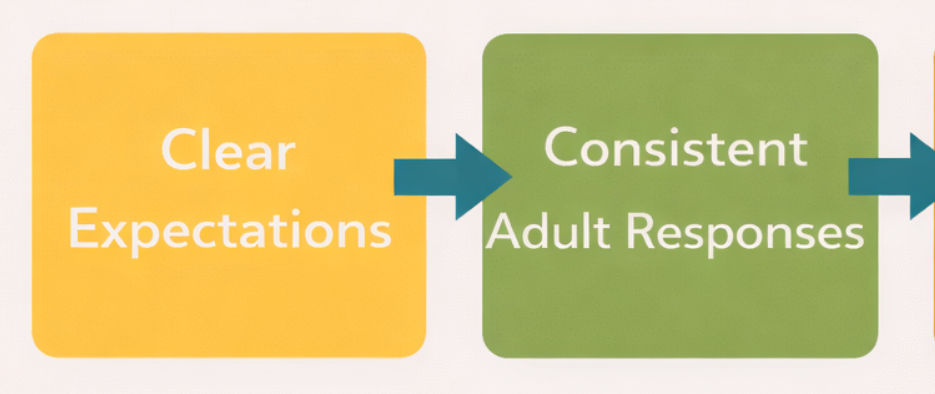
That matters because role clarity does not stand alone. It works best when it is connected to:
training
shared expectations
classroom systems
communication structures
ongoing problem-solving
In other words, a strong high-support classroom is not built by handing adults a room assignment and hoping they figure it out. It is built by giving the team a shared operating system.
Role clarity reduces tension and strengthens culture
A lot of adult conflict in classrooms is not actually about personality. It is about uncertainty.
When staff members are unclear about who leads what, who communicates decisions, who handles behavior follow-up, who adjusts materials, or who owns documentation, frustration grows fast. People can start feeling micromanaged, unsupported, underused, or blamed for things they were never actually responsible for.
Clear roles do not solve every adult challenge,
but they remove a lot of unnecessary friction.
That is one reason I think school leaders should pay much more attention to role clarity in specialized settings. If leaders want stronger classroom culture, better student support, and more sustainable staffing, they have to help teams define how the work is supposed to function.

What school leaders should pay attention to
For leaders, role clarity is not a one-time orientation topic. It is something that has to be built, revisited, and supported.
That means asking questions like:
Do teachers and paraeducators have a shared understanding of their roles?
Are classroom responsibilities defined clearly enough to support instruction and behavior systems?
Do paraeducators receive training for the specific systems used in the classroom?
Are expectations around communication, documentation, and professionalism explicit?
Are leaders helping teams resolve role confusion before it turns into conflict?
These are leadership questions because unclear adult systems can quietly undermine strong student supports.
What this means for my leadership
This is one of the places where my leadership has become much more systems-focused.
Earlier in my career, I probably would have looked at adult confusion in a classroom and treated it mostly as an interpersonal issue. Now I look first at the structures. I want to know whether expectations are actually clear, whether roles have been defined well, whether training has been provided, and whether the team has systems strong enough to support consistency.
That shift matters.
Because when students have intensive needs, adults cannot rely on informal assumptions. High-support classrooms need clear instructional leadership, clear paraeducator roles, clear behavior systems, and clear routines for communication and follow-through.
Role clarity is not a small operational detail. It is part of how we protect dignity, consistency, and access for students.

 | In high-support classrooms, unclear staff roles can lead to inconsistent instruction, uneven behavior support, weak communication, duplicated effort, and confusion that ultimately affects students. |
 | A strong classroom system clearly defines teacher and paraeducator responsibilities across instruction, behavior support, data collection, classroom organization, student advocacy, and collaboration, while connecting those roles to shared training and classroom systems. |
 | When role clarity is strong, adults work more cohesively, classrooms function more predictably, and students experience more consistent support, clearer routines, and stronger access to instruction. |

Comments